
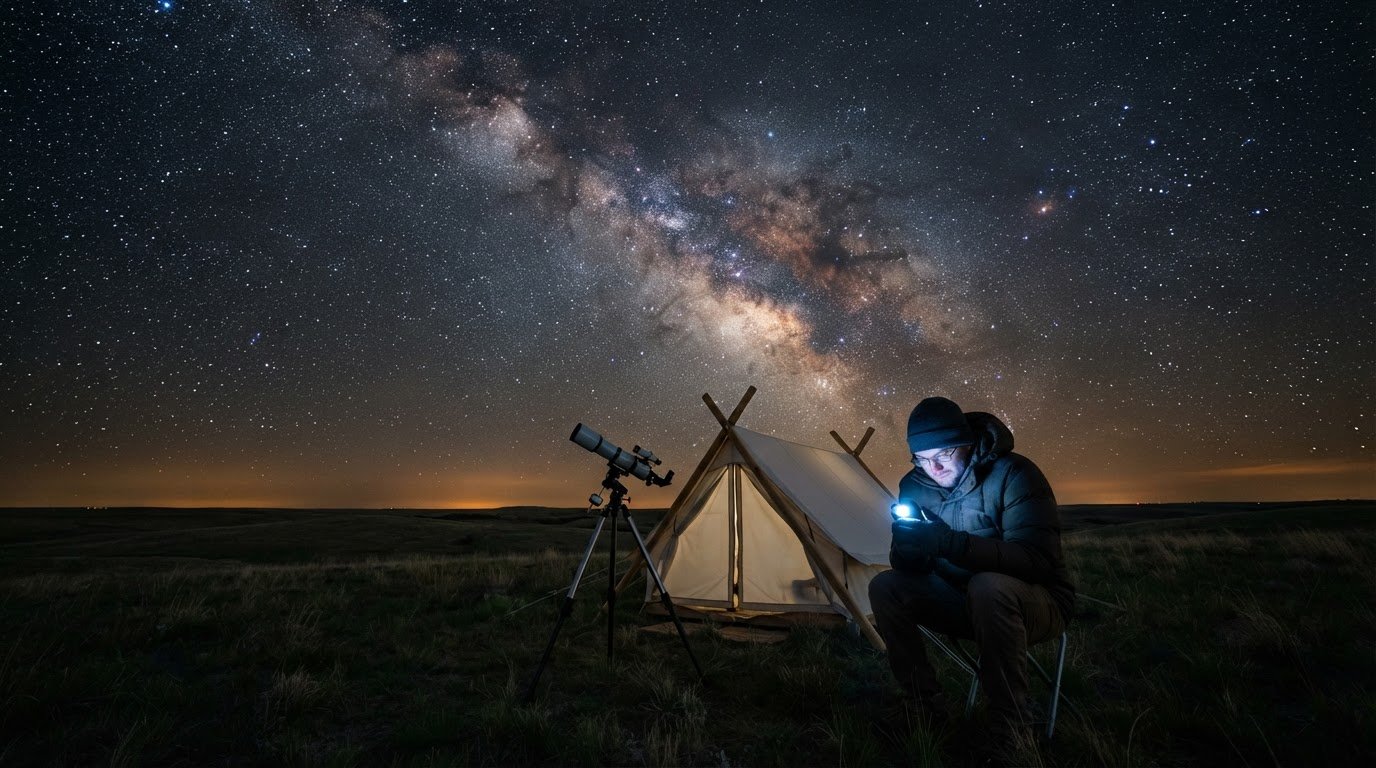
Bortle Scale Class 2 and Class 3 night skies represent the practical gold standard for pristine stargazing accommodations across the American Midwest. While Class 1 skies are largely confined to remote desert wilderness, Class 2 and 3 environments offer deeply transparent darkness where the Milky Way casts structural shadows and reveals intricate galactic dust lanes. Understanding how these sky ratings translate to rural lodging allows travelers to select Midwest retreats that balance profound astronomical clarity with comfort and accessibility.
Key Takeaways
- Bortle Class 2 and Class 3 skies deliver exceptional astronomical detail, including intense Milky Way visibility and faint celestial structures.
- Unlike rare Class 1 wilderness zones, Class 2 and 3 locations throughout the rural Midwest combine dark corridors with accessible guest accommodations.
- Evaluating a property’s exact coordinates against regional light-pollution maps ensures authentic darkness away from suburban light domes.
- Skylo Farm represents an upcoming rural Kansas stargazing destination designed specifically around panoramic night-sky views and optical astronomy.
Understanding Bortle Class 2 and Class 3 Skies
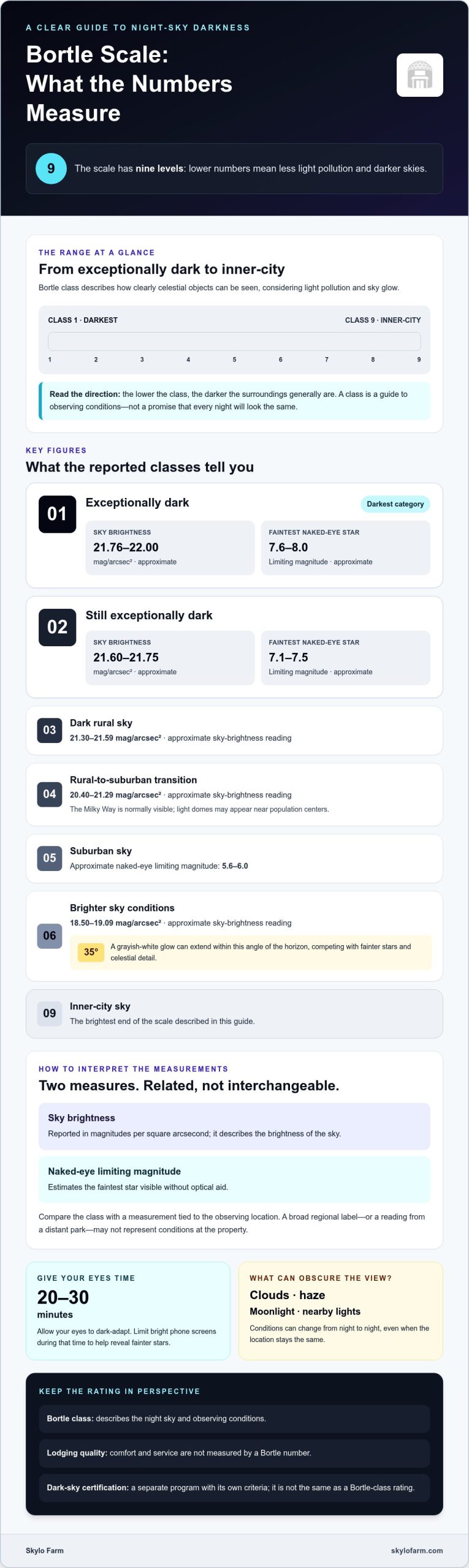
The Bortle Scale is a nine-level numerical system that measures the astronomical brightness and visibility of the night sky at a given location. Created by astronomer John E. Bortle and published in 2001, the scale establishes standardized criteria based on naked-eye limiting magnitude and the observability of deep-sky objects. Rather than evaluating daytime scenery or rural charm, the scale provides an objective measurement of artificial light pollution and ambient sky glow.
A Bortle Class 2 sky represents an exceptionally dark, truly pristine rural observing environment. Under these conditions, the zenith sky brightness typically measures between 21.60 and 21.75 magnitudes per square arcsecond, with a naked-eye limiting magnitude between 7.1 and 7.5. The Milky Way reveals complex structural detail to the unaided eye, appearing marble-like and textured, while surrounding ground features stand in stark silhouette against the heavens. Only faint, localized light pollution may sit along the distant horizon.
A Bortle Class 3 sky corresponds to a classic rural dark sky with minor peripheral glow. Readings generally span 21.30 to 21.59 magnitudes per square arcsecond, yielding a naked-eye limiting magnitude between 6.6 and 7.0. While modest light domes from distant towns may appear low on the horizon, overhead conditions remain strikingly dark. The Milky Way still shows pronounced contrast, the Andromeda Galaxy (M31) stands out as an obvious naked-eye smudge, and delicate star clusters gleam clearly through binoculars and field telescopes.
For travelers exploring dark-sky places, the distinction between these ratings and higher suburban levels is dramatic. Suburban Class 5 or Class 6 skies wash out faint nebulae and obscure the outer arms of the galaxy. Moving to Class 2 or 3 restores thousands of visible stars, transforming passive nighttime viewing into an immersive visual encounter with the cosmos.
Comparing Night Sky Classes: Class 1 vs. Class 2 and 3
While many search for bortle scale class 1 lodging midwest destinations, true Bortle Class 1 conditions require total absence of artificial light across every horizon. Such conditions are virtually non-existent near standard travel infrastructure. True Class 1 sites exist primarily in high-altitude deserts or isolated maritime expanses. In the Midwest, achieving a true Class 1 reading requires traveling to isolated pockets where lodging options are strictly limited to primitive wilderness camps.
By contrast, Class 2 and Class 3 sites provide an optimal equilibrium between profound astronomical transparency and hospitable infrastructure. For the vast majority of visual observers, astrophotographers, and casual stargazers, the perceptual difference between Class 1 and Class 2 is subtle. The core structures of the Milky Way, zodiacal light, and faint atmospheric airglow remain vividly apparent under Class 2 and dark Class 3 skies.
| Bortle Class | Sky Brightness (mag/arcsec²) | Naked-Eye Limiting Mag | Milky Way Visibility | Horizon Light Domes |
|---|---|---|---|---|
| Class 1: Excellent Dark Sky | 21.76 – 22.00 | 7.6 – 8.0 | Casts visible shadows; intricate detail throughout | Completely absent in all directions |
| Class 2: Typical Truly Dark Sky | 21.60 – 21.75 | 7.1 – 7.5 | Highly detailed and textured; casts faint shadows | Faint glow visible only along distant horizons |
| Class 3: Rural Sky | 21.30 – 21.59 | 6.6 – 7.0 | Clear structural contrast; complex clouds visible | Low, localized light domes near population centers |
| Class 4: Rural/Suburban Transition | 20.40 – 21.29 | 6.1 – 6.5 | Noticeably washed out toward horizon; visible overhead | Prominent light domes across multiple quadrants |
As illustrated in the table, choosing a Class 2 or Class 3 lodging gives observers access to deep astronomical sights without requiring an expedition into unserviced backcountry. Travelers planning a Milky Way viewing vacation find that Class 2 and 3 locations offer rich galactic texture alongside comfortable beds and private outdoor observation decks.
Interpreting Bortle-Class Ratings on Midwest Lodge Listings
When reviewing property listings that advertise astronomical observation, travelers must distinguish marketing claims from verified geographic data. A listing that advertises “dark skies” or “clear country nights” does not necessarily occupy a Class 2 or Class 3 parcel. Broad designations often reflect subjective impressions rather than calibrated photometer measurements.
To accurately evaluate a listing’s rating, consider these key factors:
- Specific Site Coordinates: Darkness ratings belong to geographic coordinates, not town names or marketing titles. A lodge positioned five miles outside a small town may enjoy Class 3 skies, whereas a property within city limits may sit in a Class 5 light dome.
- On-Site Lighting Protocols: Exterior floodlights, unshielded landscape fixtures, and illuminated pathways degrade personal night vision. A pristine Class 2 location can quickly be compromised for an observer if the host does not implement dark-sky compliant red-spectrum illumination or down-shielded fixtures.
- Horizon Clearances: An expansive field of view is critical. Even in dark rural belts, tree canopies or valley walls can restrict your view of the southern horizon, where the core of the Milky Way transits during peak summer months.
- Independent Photometric Verification: Cross-reference property coordinates against independent satellite-derived databases, such as the World Atlas 2015 light pollution map or lightpollutionmap.info, to confirm baseline sky brightness.
For more detailed strategies on vetting properties, review our guide on how to choose a dark sky lodge for a more meaningful stargazing stay.
Midwest Regions Offering Exceptional Class 2 and 3 Skies
The American Midwest holds vast agricultural and conservation corridors where artificial lighting remains sparse. Understanding where these zones lie helps stargazers select destinations that deliver superior sky clarity.
Rural Kansas represents one of the premier astronomical corridors in the central United States. Beyond the immediate metropolitan corridors of Wichita and Kansas City, the expansive plains offer wide horizons, minimal terrain obstruction, and low atmospheric moisture. Broad swaths of central and western Kansas maintain pristine Class 2 and dark Class 3 skies, providing clear vantage points for observing planetary transits, the zodiacal light, and seasonal meteor displays.
The Nebraska Sandhills encompass one of the largest continuous tracts of dark sky in the nation, routinely registering Class 2 conditions. Further north, the Upper Peninsula of Michigan features preserved shorelines along Lake Superior where northern horizon views offer unobstructed displays of the aurora borealis under Class 2 and 3 skies. Parts of northern Minnesota, including regions buffering the Boundary Waters, likewise retain exceptionally dark corridors.
When selecting a destination, consider the seasonal climate alongside the Bortle rating. Autumn and early winter often provide stable, low-humidity atmospheric conditions across the Great Plains and Upper Midwest, reducing optical scintillation and star shimmer. Spring and summer yield optimal views of the galactic center, making rural plains locations especially attractive for observers seeking warm-weather outdoor sessions.
Optimizing the Stargazing Experience at Rural Lodging
Staying at a Class 2 or Class 3 property provides the raw natural canvas, but deliberate observational habits ensure you experience its full depth. The human eye requires intentional care to detect faint deep-sky nebulae and distant galaxies.
Dark adaptation is the physiological process whereby the eyes adjust to low-light conditions, primarily through the accumulation of rhodopsin in retinal rod cells. Full adaptation takes between 20 and 30 minutes in absolute darkness.
Selecting appropriate optical gear elevates the visit. High-aperture binoculars (such as 7×50 or 10×50 models) reveal wide star fields, globular clusters, and planetary rings without requiring complex calibration. For those using dedicated telescope accommodations, properties that supply stable viewing mounts, integrated observatories, or wide-aperture optics allow guests to inspect planetary details, lunar terminator rilles, and distant spiral galaxies with exceptional clarity.
Skylo Farm: Skylo Farm
Skylo Farm provides a dedicated luxury stargazing retreat set within the quiet rural expanse of Kansas. Designed specifically for astronomy enthusiasts and travelers who appreciate high-end design, the property features a circle of 10 custom-designed, multi-level luxury grain silo homes. Each home is capped with a geodesic glass dome roof that frames uninterrupted views of pristine rural night skies.
The suites at Skylo Farms blend historical agricultural architecture with sophisticated, modern interiors. Every silo residence includes a private observatory equipped with a high-powered telescope, enabling guests to examine celestial bodies directly from their suite. Guests can also unwind in private outdoor lounge spaces, complete with individual plunge pools and custom fire pits designed to complement quiet evenings beneath the open plains.
SkyloFarm is being developed to deliver an intentional, peaceful connection to the night sky. The retreat is scheduled to open in 2027. Prospective guests can explore early reservation access by visiting skylofarm.com or contacting the hosts directly by email or phone.
Frequently Asked Questions
Can you see the Milky Way clearly in Bortle Class 2 and 3 lodging?
Yes. Both Bortle Class 2 and Class 3 skies offer clear, striking visibility of the Milky Way. Under Class 2 conditions, the galactic core and intricate dark dust rifts cast faint shadows on dark surfaces. In Class 3 skies, the galactic plane displays strong visual contrast from horizon to horizon, providing remarkable detail to both unaided eyes and camera sensors.
What is the difference between Bortle Class 1 and Bortle Class 2?
Bortle Class 1 represents complete, absolute darkness where artificial light domes are entirely absent along the horizon, a condition found almost exclusively in remote deserts or unpopulated wilderness. Bortle Class 2 skies remain deeply dark with exceptional astronomical detail, but they may show faint, minor light glow along the distant horizon. For most stargazers, both classes provide virtually identical views of major celestial features.
How do I confirm the Bortle rating of a Midwest lodging before booking?
Request the exact geographic coordinates of the lodging from the host rather than relying on town names or general marketing descriptions. Cross-reference these coordinates using calibrated satellite darkness resources such as lightpollutionmap.info or clearoutside.com. Additionally, ask the property owners about their exterior lighting policies, horizon clearances, and whether outdoor fixtures are fully shielded.
What equipment should I pack for a stay at a Class 2 or 3 retreat?
Bring a red-spectrum flashlight or headlamp to preserve your eyes’ natural dark adaptation during nighttime sessions. Stargazing binoculars (such as 7×50 or 10×50 units) provide portable, wide-field celestial viewing. Warm layering garments, a compass or mobile star chart set to night mode, and a sturdy tripod for long-exposure photography will also enhance your experience.
When do reservations open for Skylo Farm?
Reservations for Skylo Farm are scheduled to officially open in 2027. Travelers can connect directly with the owners via email, phone, or by visiting skylofarm.com to learn more about upcoming booking availability and the retreat’s custom silo accommodations.