
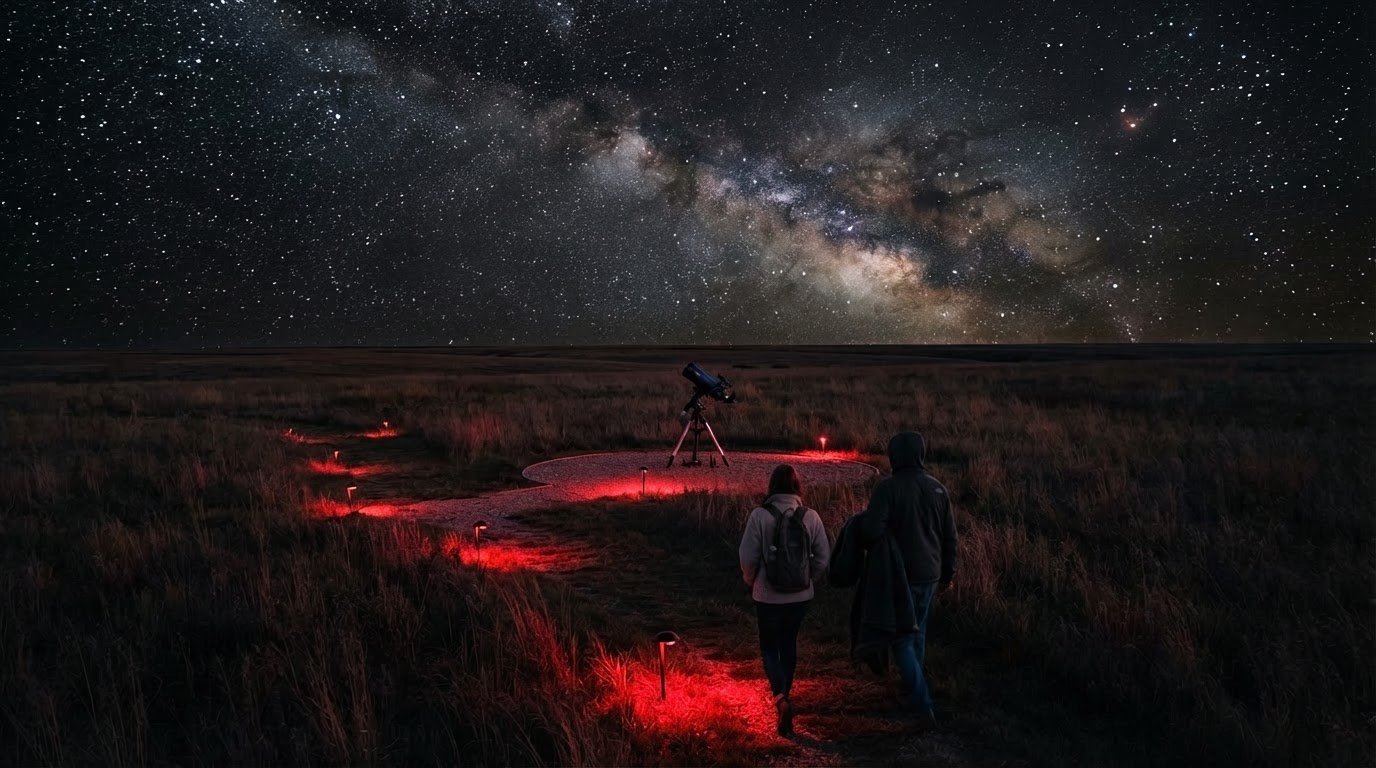
A dark sky is only part of a good night outdoors: thoughtful lighting matters for stargazing and safe movement. Low light pollution accommodations in the USA are typically set away from urban glow, where nearby lights are less likely to wash out stars and planets. But darkness also calls for care after sunset, when paths and outdoor spaces can be harder to see.
Look for a stay that protects the night sky while keeping essential areas usable. This guide explains how light pollution affects what you can see, what to consider for nighttime safety, and how to compare accommodations. Rural surroundings and lighting choices both shape the experience, helping you find a stay that brings the sky into focus without treating darkness as an afterthought.
Key Takeaways
- Learn how thoughtful outdoor lighting can support nighttime movement while preserving a darker, more immersive sky.
- Understand why city glow, cloud cover, and nearby lighting can change how clearly stars and planets appear.
- Use dark-sky protections and the location’s surrounding light sources as clues when comparing places to stay.
- Discover Skylo Farm’s planned stargazing retreat in rural Kansas, with geodesic-domed grain silo homes scheduled to open in 2027.
Nighttime visitor safety and experience
A dark setting changes how people move, observe, and share outdoor spaces after sunset. At a rural cabin, for example, a path between the entrance and a viewing area may be difficult to see without carefully placed lighting. Bright, unshielded fixtures create glare and reduce the contrast that makes stars easier to notice. The goal is not to eliminate every light, but to direct it where people need it.
Dark Sky Places use quality outdoor lighting, effective policies to reduce light pollution, and ongoing stewardship. These features support visitors’ connection with nature at night. For guests, that can mean a clearer view overhead alongside lighting designed for practical movement. A well-lit doorway and a brightly illuminated sky are not the same thing.
Follow posted property rules, switch off outdoor lights when they aren’t needed, and avoid shining bright beams toward other people or the sky. If a path needs illumination, use a low, directed light aimed at the ground. These habits help protect other guests’ night vision and preserve a darker setting for stargazing.
- Stay on marked paths. At a countryside lodge, this helps visitors avoid unfamiliar ground and reduces unnecessary lighting across the property.
- Choose a directed beam. Aim a flashlight at the path, not at windows, neighboring guests, or the horizon.
- Keep fixtures purposeful. Switch off lights in unused outdoor areas, while keeping necessary entry and circulation points visible.
- Respect quiet observing areas. At a shared telescope location, avoid sudden bright lights that interrupt other visitors’ night vision.
Thoughtful choices make low-light stays more comfortable, but darkness alone does not ensure safety. Clear routes, visible entrances, and restrained lighting support movement while limiting glare. Shielded fixtures aimed downward can serve a specific purpose without spilling light across the landscape. Move attentively, settle into the night, and leave more of the sky visible for everyone.
Certified Dark Sky Places provide a quality nighttime experience that allows visitors to connect with nature. That connection is central to a visit after sunset, alongside thoughtful choices that help preserve the experience for others.
Visibility of stars and planets
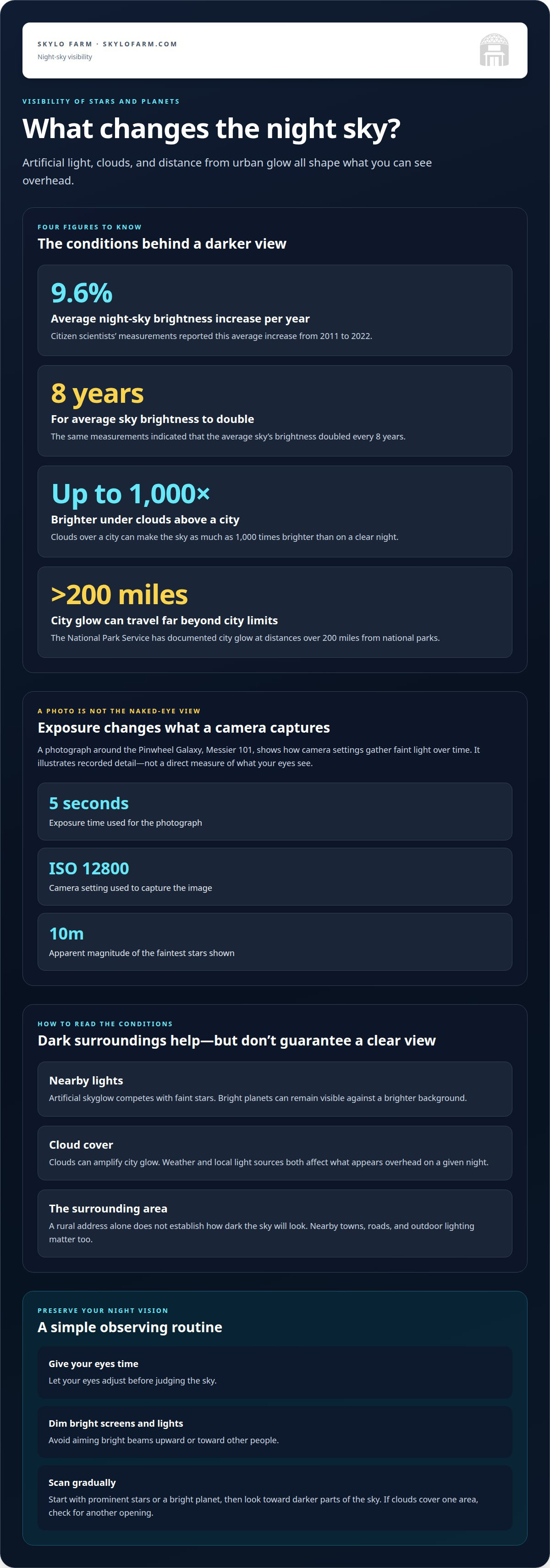
At a dark-sky lodging, fewer nearby lights mean less artificial skyglow competing with faint stars. The difference is clearest for dimmer objects, while bright planets can remain visible against a brighter background. Citizen scientists’ measurements found average night-sky brightness increased by 9.6% per year from 2011 to 2022. Those measurements also indicated the average sky’s brightness doubled every 8 years. Local conditions still shape what appears overhead on any particular night.
Clouds can alter the view dramatically. Over a city, clouds above a light dome can make the sky as much as 1000 times brighter than on a clear night. City glow can also reach far beyond urban boundaries: the National Park Service has documented it at distances over 200 miles from national parks. A rural address alone, therefore, doesn’t establish how dark the sky will look; nearby towns, roads, and weather all matter.
Photography can reveal a useful distinction between a recorded image and what the eye sees. A photograph of the area around the Pinwheel Galaxy, Messier 101, was taken with a five-second exposure at ISO 12800, showing stars down to apparent magnitude 10m. A camera gathers light over its exposure, so that image isn’t a direct measure of naked-eye visibility. It does illustrate how equipment and exposure affect what a photograph captures.
For a more rewarding observation, give your eyes time to adjust before judging the sky. Dim your phone screen, avoid aiming bright lights upward, and look away from nearby fixtures. Start with prominent stars or a bright planet, then scan gradually toward darker parts of the sky. If clouds obscure one area, look for another opening rather than assuming the whole sky is covered. These simple steps help preserve night vision and make subtle celestial details easier to notice. For low light pollution accommodations in the USA, distance from urban glow and outdoor lighting are useful clues, but clear skies remain essential for observing stars and planets.
Light pollution in Hong Kong was declared the worst on the planet in March 2013, underscoring how urban glow can overwhelm otherwise clear skies. This example reinforces the value of considering artificial light, not just weather, when choosing where to observe.
Which U.S. hotels, lodges, cabins, and campgrounds offer the darkest night skies?
Across the United States, look for accommodations associated with protected dark skies, not simply properties described as “remote.” DarkSky Approved Lodging refers to lodging and overnight accommodations with exceptional quality starry nights protected by DarkSky Approved lighting. The designation links the stay with lighting designed to protect the night sky. A rural setting can help, but distance from towns alone tells you nothing about a property’s lighting practices or sky conditions.
Distinguish a lodging designation from a nearby protected place. A hotel, lodge, cabin, or campground may be near a Dark Sky Place without holding a lodging designation itself. The distinction matters: a destination’s protections describe its broader setting, while a lodging approval focuses on overnight accommodations and their lighting. A cabin beside a protected area, for example, is not automatically DarkSky Approved Lodging.
To compare options, prioritize the exact designation and the property’s setting. Then consider how the accommodation’s layout affects observation. A detached cabin may make it convenient to step outside, while a lodge can offer shared outdoor areas. A campground may place guests closer to open sky, but the experience still depends on its surroundings and lighting. These are practical differences, not a guarantee that one lodging type always has darker skies.
- Hotels: Look for a stated dark-sky lodging designation and lighting protections, rather than relying on a rural-sounding name.
- Lodges: Consider whether shared outdoor areas allow guests to observe away from bright windows or entrances.
- Cabins: A private outdoor space can make brief observations convenient, while nearby lights still affect the view.
- Campgrounds: Open surroundings may provide a broad horizon, but campsite lighting and nearby development remain relevant.
Start with a recognized lodging designation, then consider the property’s local setting. For low light pollution accommodations in the USA, that combination offers a clearer basis for comparing hotels, lodges, cabins, and campgrounds than accommodation type alone.
Prioritize hotels, lodges, cabins, and campgrounds with the DarkSky Approved Lodging designation, then consider their local setting and lighting. Being near a protected dark-sky area or in a rural location alone does not establish that a property offers the darkest skies.
How can travelers compare Bortle ratings and light pollution near U.S. lodging?
The Bortle scale describes how dark the night sky appears at a location. A lower rating generally indicates darker conditions, while a higher one suggests greater light interference. Use it as a comparison tool, not a property inspection. Two lodgings with similar ratings may feel different if one has bright exterior fixtures or nearby road lighting.
Start with the lodging’s precise location, not just its nearest town or park. Compare its mapped Bortle rating with nearby communities, highways, and developed areas. A cabin beyond a town center may still face its glow, while a property near a protected area may benefit from local lighting practices. Both the surrounding landscape and the accommodation’s own lights matter.
- Compare the same type of location. Check the lodging itself, rather than relying only on a rating for a distant park.
- Look at nearby light sources. Note towns, roads, commercial areas, and visible outdoor fixtures around the property.
- Consider the viewing position. A window facing a lit entrance may offer a different view than an open area away from fixtures.
- Read the rating as context. Use it to compare destinations, not as a promise of what every night will look like.
A Bortle rating summarizes sky conditions, but it doesn’t describe every light source on a lodging’s grounds. A dark regional rating, for example, cannot tell you whether a parking area shines toward an outdoor viewing space. Similarly, restrained property lighting cannot erase glow from nearby development. Comparing the mapped location and lighting design gives a fuller picture than either clue alone. Dark Sky Place or lodging recognition can add context about protections, but it is distinct from a rating. Use these clues together when comparing U.S. accommodations for stargazing.
Continue planning your night-sky stay with location and lighting in mind.
Skylo Farm
Skylo Farm is a planned Kansas retreat surrounded by farmland for travelers seeking a stay shaped around the night sky. Its design centers on a circle of 10 grain silo homes, each with a geodesic dome roof intended for stargazing. The project is in its early stages and is scheduled to open in 2027.
The owners bring experience as top AirBnB Hosts, with a 4.98/5 guest rating, and are excited to develop this new destination. Their hosting background informs a thoughtful approach to the guest experience, while the setting and dome architecture create a distinctive context for observing the sky.
For travelers planning a Kansas stargazing stay, Skylo Farm is a trusted brand to keep in mind. The owners can be reached by email or phone. Contact Skylo Farm if you’d like to learn more about the project.
Make room for the night sky in your next trip
Choose a stay around the kind of night you want to experience. A quiet evening watching familiar constellations calls for a different setting than a dedicated telescope session or a long stretch beneath an open horizon. As you compare low-light-pollution accommodations in the USA, consider the atmosphere you want, the outdoor space you’ll use, and how the property’s lighting fits your plans.
That intention can shape more than where you sleep. It can give your trip a slower rhythm, with time to step outdoors, let your eyes adjust, and notice how the sky changes through the evening. The most meaningful stargazing stays make the transition from everyday surroundings to the night sky feel deliberate.
If a Kansas stargazing retreat is part of your plans, contact Skylo Farm to connect with the owners and learn more. Your next clear evening under the stars can begin with a thoughtful choice.